The Urumea River: History, bridges, scenery and routes to explore it like a local
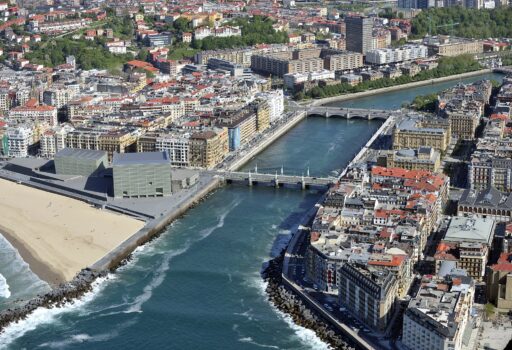
The origins and history of the Urumea River The Urumea River flows through San Sebastián, dividing the city in two. The Urumea River in San Sebastián is one of the city’s most iconic natural features and a perfect place for strolling, playing sports, or enjoying nature. It is a fairly short river, only 45 kilometers […]
Categories
The origins and history of the Urumea River
The Urumea River flows through San Sebastián, dividing the city in two. The Urumea River in San Sebastián is one of the city’s most iconic natural features and a perfect place for strolling, playing sports, or enjoying nature. It is a fairly short river, only 45 kilometers long, whose source is in Ezkurra, in the mountains of Navarre, one of the rainiest places on the Iberian Peninsula. The source of the Urumea River is thus located in a mountainous setting rich in natural beauty.
If you look for the Urumea River on a map, you’ll see that it flows through various towns before emptying into the sea in Donostia-San Sebastián, connecting Navarre with Gipuzkoa and forming an essential part of the urban and natural landscape.
In Gipuzkoa it is known as Urumea, a name of uncertain origin, although experts believe it may derive from Ur Humea, the name by which it was known in the 12th century and which could be a corruption of ur (water) + mehe (thin, narrow) + a (article). In Navarre, however, in the Goizueta area, it is known as Errakaundi (large stream).
The importance of the Urumea River in the life of San Sebastian
Like any river, the Urumea has played a vital role in the city of San Sebastian, but its importance extends beyond the city itself; for centuries, it has served as one of the main routes for transporting cider, timber, food and people from the interior of the province and Navarre to the capital of Gipuzkoa. Towns such as Hernani, Astigarraga and the aforementioned Goizueta have used the river as a transport artery until relatively recently. The Urumea River in San Sebastián has historically been a key driver of the city’s economic and social development.
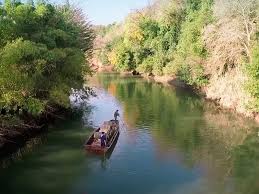
Its bed consists of sand, so in the past the river was a source of this material for construction, livestock farming, and agriculture. The so-called gabarreros or sand dredgers would come from Loyola in their pole-propelled barges and anchor in the area near the mouth of the river. It was a job dictated by the tides, as the sand was extracted at low tide and the boats were rowed back up the river when the tide began to rise.
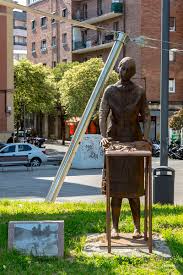
Its clear waters have also been used for washing, as in the past women would come to the river to wash clothes, a very hard task that caused a great deal of damage to their hands, partly because the water flowing down from the mountains is very cold. In tribute to these women, there is a sculpture in the Loyola neighborhood, which we usually see on our Classic E-Bike Tour.
Nowadays, the Urumea is mainly used for leisure activities; in summer in particular, it is very common to go to the river for a swim rather than to the beach, where it is hotter and the salt and sand can be a nuisance for some people.
The most iconic bridges over the Urumea
Obviously, a river is nothing without its bridges; let’s take a look at the most important ones in the Urumea River in San Sebastian:
María Cristina Bridge
The most spectacular of these was opened in 1905, on Saint Sebastian’s Day, to link the North railway station with the city center. Its four monumental obelisks, inspired by the Alexandre III Bridge in Paris, are the most distinctive feature of this bridge, which is also notable for its street lamps and its pink granite. It is named in honor of Queen María Cristina, who at the time spent her summers in the city with her son, King Alfonso XIII, and who, naturally, attended the opening ceremony.
Santa Catalina Bridge
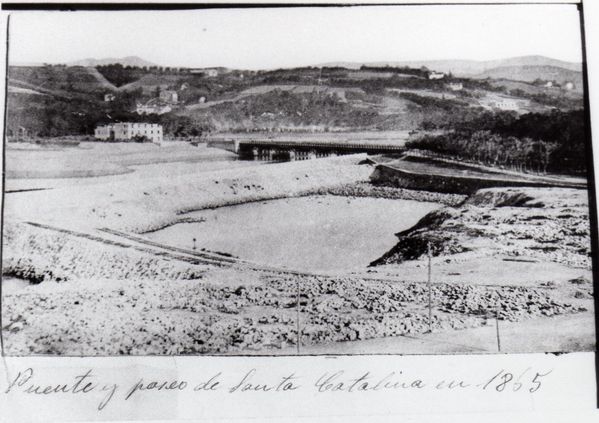
The first bridge in the city’s history was made of wood until 1872 so that it could be easily destroyed in the event of an invasion. Its name comes from an old, tiny neighborhood outside the walls of San Sebastián, which consisted of just a few houses and a chapel dedicated to the saint. This bridge links the city center with the Gros district, and although it cannot compete with the María Cristina Bridge in terms of appearance, its importance to the region’s traffic for centuries (the main road used to pass through here) is undeniable.
Zurriola Bridge
The closest to the sea, the Zurriola or Kursaal Bridge, was opened in 1915 to link the Alameda del Boulevard with Zurriola Beach. Built in the Art Deco style, its street lamps are its most distinctive feature. It is our most culturally significant bridge, as it connects the Victoria Eugenia Theatre with the Kursaal Auditorium, and during the San Sebastian Film Festival it is sometimes used as part of the red carpet. It is also the bridge most exposed to the force of the sea, making it a superb spot to watch the waves when the Cantabrian Sea is in full fury (always from a distance, of course; we recommend the terraces of the Kursaal for this).
Walks and routes along the banks of the Urumea
A stroll along the Urumea River is a real pleasure, especially in recent years since a wonderful promenade has been created along the entire riverbank all the way to Astigarraga. There are plans to extend it in the coming years, which makes us very happy. Of course, you can enjoy these walks on foot, but also by bike, as there is a cycle path or ‘bidegorri’, running the entire length of the route.
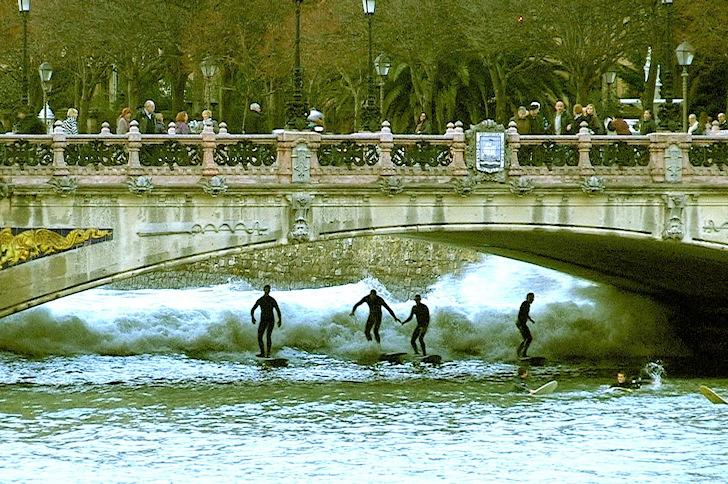
Centro section
The best-known section takes us from the mouth of the river to the Loyola neighborhood. Both sides are very pleasant, with beautiful Romantic-style buildings, mainly on the left-hand side. However, if you walk along the right-hand side, there will come a point where you’ll have to cross the river, either via the Real Sociedad bridge or the Mikel Laboa footbridge leading from Cristina Enea Park. Both options will take you to the Riberas de Loyola neighborhood.
Section towards Martutene
From Riberas de Loyola onwards, the walk can only be taken on one side of the river. This is largely a new walkway, built to control the Urumea River, which used to overflow during the rainy season. Although at times we have to walk amongst the houses, a little way from the river, it is a very pleasant walk, and, as we have already mentioned, it is a work in progress, so in the coming years it will be even better than it is now. Following this walk, as we’ve already mentioned, we can reach Astigarraga, the source of almost all the cider consumed in the Basque Country. We recommend visiting Sagardoetxea, the Basque cider museum, as the main stop on the walk; you won’t regret it.
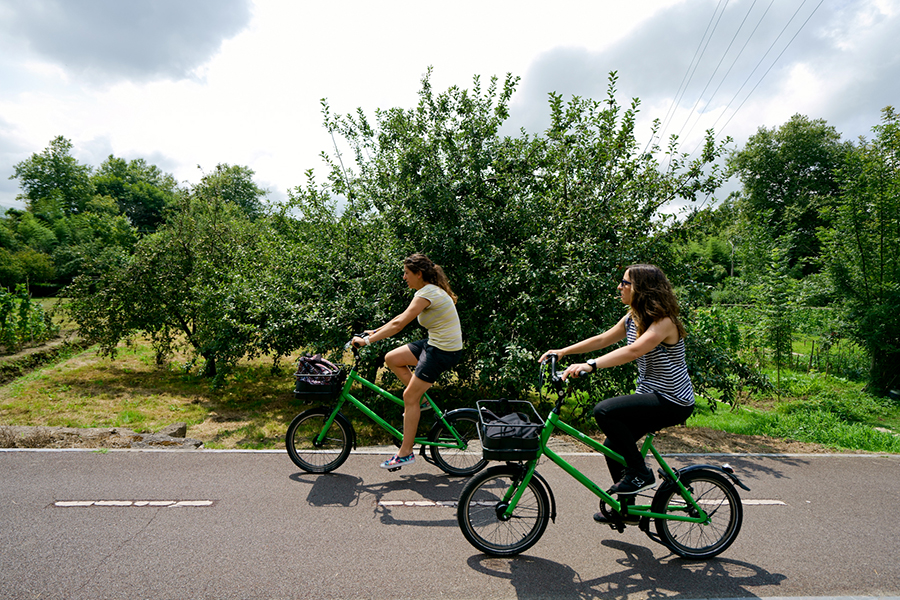
You can also bike to Sagardoetxea, rent our bikes for as long as you need to explore the city, or contact us to learn more!
Fauna, flora and natural curiosities
The Urumea River is one of the best-preserved rivers in Gipuzkoa, boasting abundant flora such as oak, ash and willow trees, as well as Monterey pines, which are native to California. We can also find animals such as the European mink and the Iberian desman, also known as the musk rat. In San Sebastian, it is not uncommon to see ducks and seagulls bathing in its waters.
As for the fish that inhabit it, we can find brown trout, eels, minnows, and loaches. In the past, there were also salmon; after several years during which they had disappeared, thanks to the efforts of the Provincial Council of Gipuzkoa, this species is gradually recovering. It is therefore not uncommon to see people fishing in the river, particularly around the Kursaal bridge.
Activities along the river: rowing, photography, running
As we have already mentioned, the Urumea river in San Sebastián is now used mainly for recreational purposes. There are always people strolling, jogging or cycling along the riverbank, as the path is practically flat all the way to Astigarraga.
As it is a fairly calm river, particularly in the final few kilometers, it is an ideal place for rowing. There are, in fact, rowing clubs along much of the river, but also the company Arrauning in Loyola, which specializes in water sports on the Urumea, where you can hire canoes and pedalos to travel up and down the river, mainly in summer.
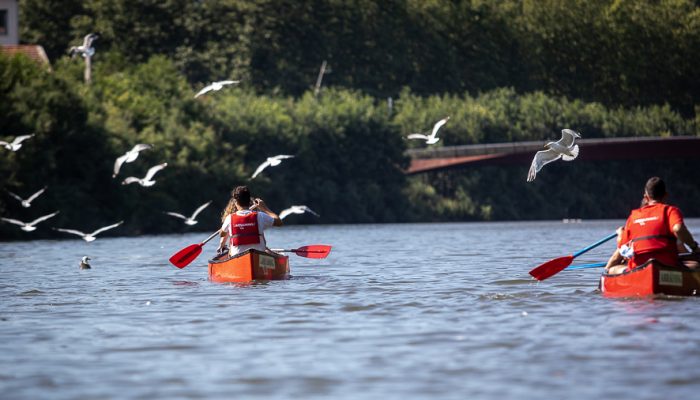
Further upstream, heading towards the mountains, the river features rapids and eddies with deep pools, making it ideal for certain types of canoeing; but as we’ve already mentioned, it’s also perfect for a dip on hot days. There are plenty of picnic areas set up for this purpose, which makes the Urumea river a fantastic alternative to the beach that we highly recommend.

My name is Alba, and although my first name doesn’t sound very Basque, my unpronounceable surname proves otherwise. I’ve lived in Donostia all my life. I’m an art historian and have been a tour guide for many years; I love travelling, languages and, of course, art.