Santiago Battery in Urgull: history, views and how to visit it
History of the battery and its defensive role The Santiago Battery was built in the late 17th century, as shown by various plans from the period, although in these it is also referred to as the Queen’s Battery, the Quay Battery or the Navy Battery. Initially, this battery consisted solely of its upper section, known […]
Categories
History of the battery and its defensive role
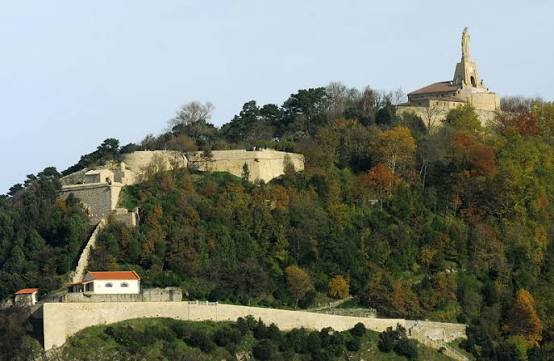
The Santiago Battery was built in the late 17th century, as shown by various plans from the period, although in these it is also referred to as the Queen’s Battery, the Quay Battery or the Navy Battery. Initially, this battery consisted solely of its upper section, known as the “old battery”, but some time later, in 1898, the lower Santiago battery, or “Costa Battery”, was added in an attempt to fortify it.
At the same time, the battery has undergone various alterations throughout its history, with the aim of reinforcing it and/or repairing the damage that has arisen over time or as a result of attacks it has suffered. Consequently, the battery has gradually evolved into a more robust and solid structure.
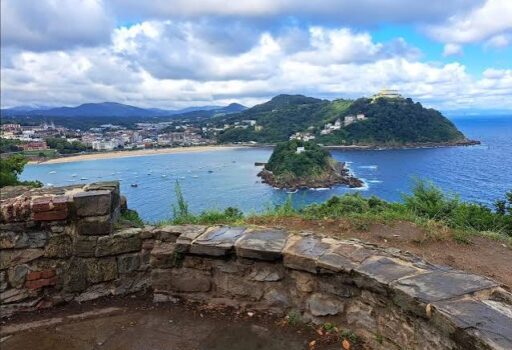
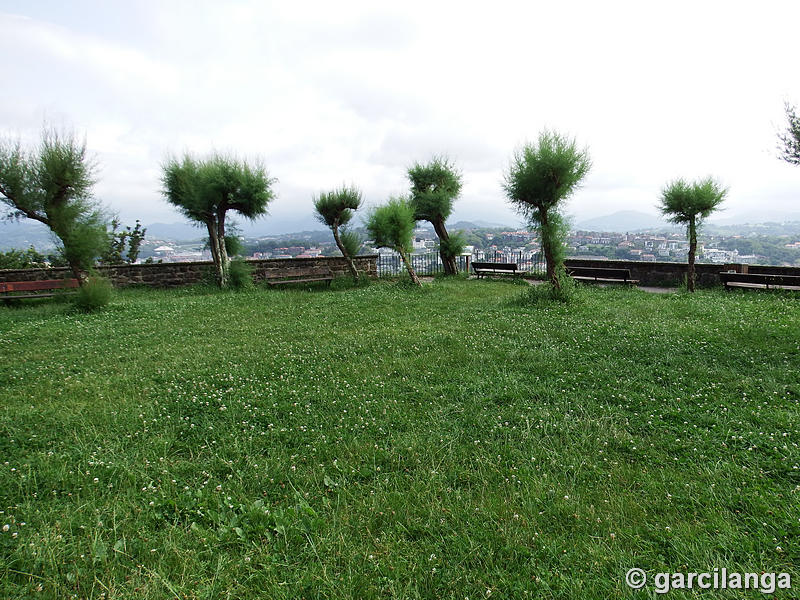
However, this appearance was lost in 1925 when the city council purchased the hill and decided to transform it into a public park. The cannons were removed, the walls were lowered, benches were installed and trees were planted to make this battery – and the hill as a whole – a more pleasant place for the people of San Sebastian to enjoy. Thus, this battery, like the rest of the batteries on Urgull, has been transformed into a recreational area and viewpoint offering some of the best views of the city and La Concha Bay.
How to get up to Urgull to visit it
Easy route
The easiest way to get to the Santiago battery is to follow the road that starts at the Paseo Nuevo, more specifically next to the car park at the foot of Mount Urgull. This is the road that was once used by horse-drawn carts to supply the troops stationed here, and which is now used by cars and buses needing to make the climb. As it is a road, it is tarmacked and the inclines are not very steep, making it perfectly accessible. Furthermore, this road ends right at the Santiago Battery, which saves us having to search for it on the maps scattered around the hill.
Route from the port
Another way to get up to the Santiago Battery is to start from the harbour. To do this, we’ll go through the Portaletas gate and turn left, heading up a short slope that leads to the steps of Ollagorra, a well-known gastronomic society. From here, we enter the public park, where the path splits in two. We take the one on the right, but rather than continuing straight on, we’ll head up the steps. Gradually, as you make your way along the path through the trees, you’ll reach the Santiago battery.
This route is more challenging, as it involves climbing stairs for most of the way, and you’ll need to keep an eye out for the signposts to ensure you don’t end up at a different battery. The Santiago battery is the one furthest up on the left; you’ll recognise it by its large meadow and because the path down to the Polvorín starts here.
Guided route
If you’d like to take a guided tour to the battery, we recommend that you get in touch with us and we’ll be delighted to help you organise something for you and your companions. If you follow the road, you can cycle to the top without any trouble, especially if you’re on an electric bike like ours.
What to see at the Santiago Battery
Cannons, ramparts, viewpoints
As we’ve already mentioned, the battery has been radically transformed for its new use as a public park, so where there used to be cannons there are now benches, and what was once a mound of earth is now a huge lawn where you can sit in the sun, play, have a picnic… They’ve even organised concerts up here!
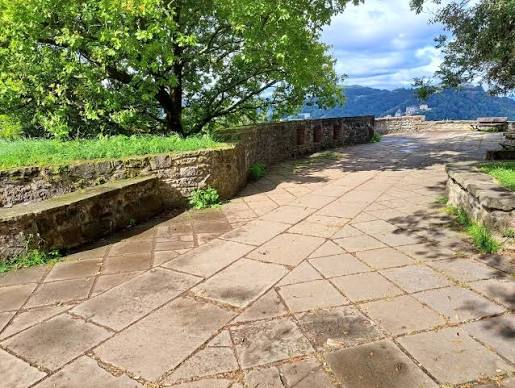
All that remains of the old battery are the walls, which can be seen from below, and the positions where the defensive cannons were once placed, now used as viewing points. In fact, from up here you have some of the best views of San Sebastian, rivalled only by those from Mount Igeldo. From here, you can see the city centre and the entire Bay of La Concha perfectly. You can also see much of the Gipuzkoa coastline and the vast expanse of the sea. In summer, it’s the perfect spot to watch the sunset.
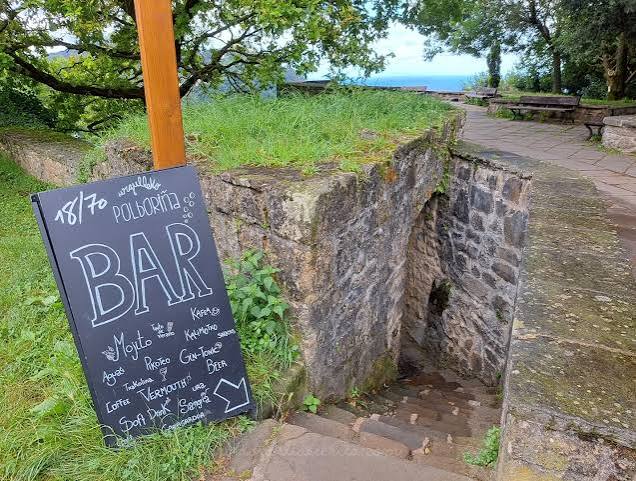
To top it all off, from here you can access the Polvorín, a bar housed in a former gunpowder store – hence the name – where you can have a drink after the climb whilst enjoying the views and, if you’re lucky, some live music. We love the Polvorín, so we might just see you up there!
Other batteries and fortifications in San Sebastian
As well as the Santiago battery, other notable sites on Mount Urgull include the lower Santa Clara battery – the best spot for watching the waves crash against the Paseo Nuevo in winter – and the Las Damas battery, which is the most visible from La Concha as it includes a building now used as a summer library. This battery is also one of the few where the cannons still face the bay.
These two batteries are probably the most visited of the entire defensive complex, as they are very easy to reach from the harbour and the Paseo Nuevo and are linked by a tarmac road. If you visit Mount Urgull, you’re bound to pass by one or the other.

My name is Alba, and although my first name doesn’t sound very Basque, my unpronounceable surname proves otherwise. I’ve lived in Donostia all my life. I’m an art historian and have been a tour guide for many years; I love travelling, languages and, of course, art.