Basque Pelota: History, variants and where to watch it
Basque pelota is one of the sports most closely associated with the Basque Country. Pelota mano, cesta punta and pala are some of the most popular sports in the region. For centuries, betting has added a great deal of excitement to these games, and the frontons remain, even today, the quintessential meeting places in the […]
Categories
Basque pelota is one of the sports most closely associated with the Basque Country. Pelota mano, cesta punta and pala are some of the most popular sports in the region. For centuries, betting has added a great deal of excitement to these games, and the frontons remain, even today, the quintessential meeting places in the Basque Country, the French Basque Country and Navarre.
What is Basque ball?
Playing with a ball has been a constant feature of human life since the dawn of humanity. There are murals dating back to the 2nd century BC depicting people entertaining themselves with a round object. They throw it, hit it, pass it and catch it. But Basque ball is a very distinctive ball game, played in a very specific geographical area and on specific pitches.
It is the only game in the world where the hand is used as a tool to hit the ball; it is played exclusively in the Basque Country (and in places where Basques have emigrated) and is played on frontons.
Distinctive features of Basque pelota
On the one hand, there is the wall as an element of the game. That is why the interaction between players is not direct; instead, the ball hits a wall before reaching the other player. This is the origin of those highly distinctive courts for playing pelota: the frontones.
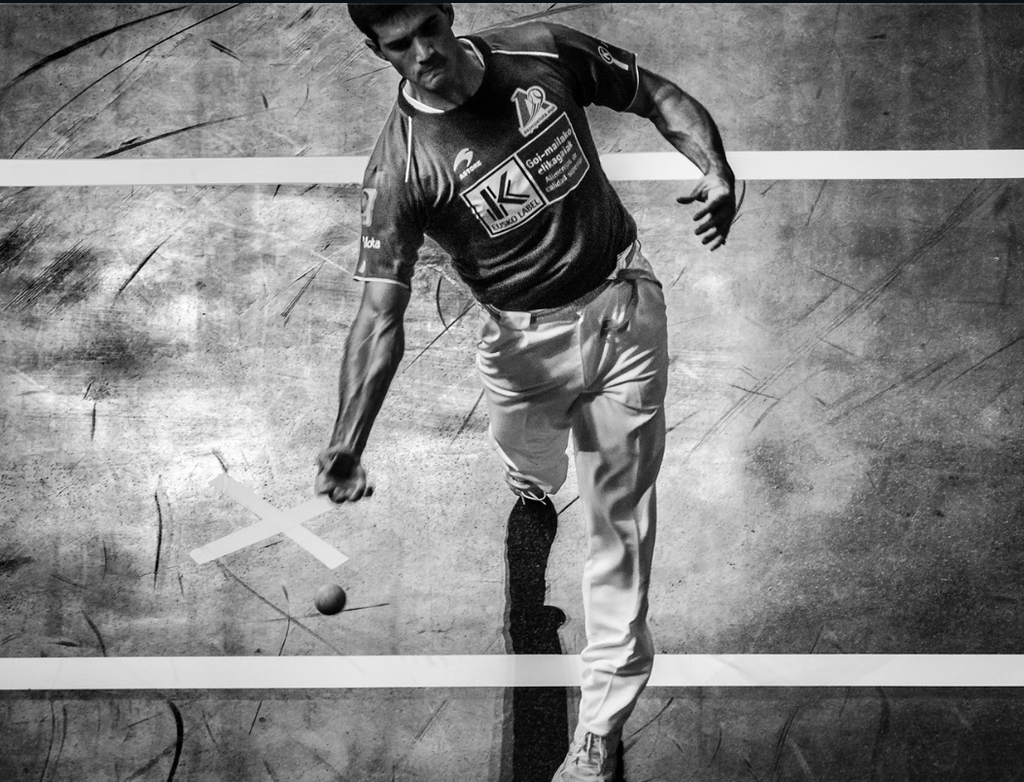
On the other hand, although there are many variants of Basque ball games (cesta punta, pala and frontenis, amongst others), there is one in which, even today, no equipment (rackets or paddles) is used, and players strike the ball with their bare hands. This technique, which has not been used since the 18th century, is the defining characteristic of pelota mano.
These two distinctive features have only been found in the Basque Country – both the French and Spanish parts – and in Navarre. Whilst in other places ball games evolved in different ways from the 18th century onwards, in the Basque Country and Navarre, Basque pelota developed.
History of Basque pelota
The history of Basque pelota begins with the French ‘Jeu de Paume’ in the 13th century. This was a form of the game played with the ball in the hand, which became popular throughout Europe over the following centuries. However, it was not until the 18th century that Basque pelota, in its true sense, came into being with its most characteristic features: the rebound wall, the leather glove, and the hand as the predominant means of throwing the ball.
From then on, the professionalisation and global spread of this sport from the Basque Country knew no bounds.
Origins: French Jeu de Paume
The Jeu de Paume, which literally means ‘Game of the Palm’ in French, is thought to be the origin of Basque pelota. It was a game played in France between the 13th and 17th centuries, which involved competitors facing each other across the court. Each team occupied one half of the court, and the aim was for the ball – which was thrown and caught by hand – to cross over and land in the opposition’s half.
There were two variants: the ‘courte paume’, which was played in small spaces, such as porticoes or palace courtyards, and which in the Basque region would be known as ‘pasaka’; and the ‘longue paume’, which was played in larger areas, such as woods or squares, and which in Basque would be called ‘bote luzea’.
The arrival of gloves, shovels and rackets
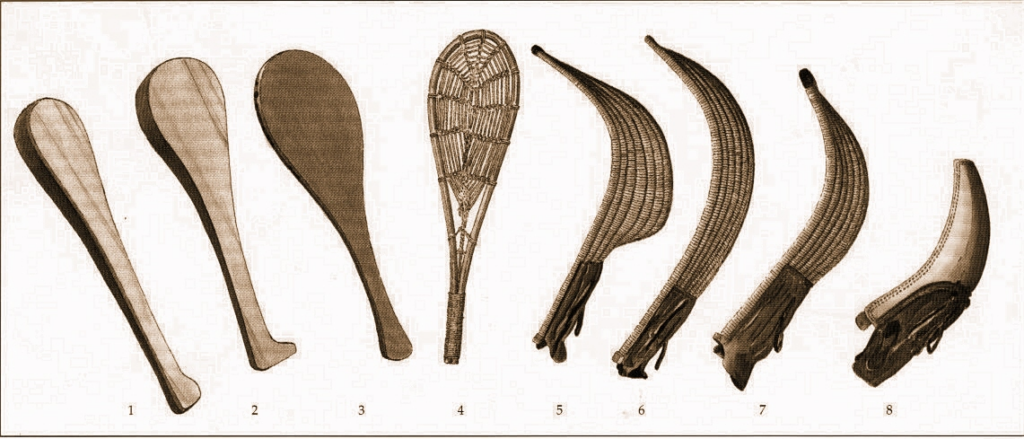
In the evolution of Basque pelota, the next significant historical milestone was the introduction of new equipment for the game. Whilst, up until the 16th century, the ball was the only physical element of the game, from that point onwards leather gloves, wooden paddles and even rackets with nets began to be used to hit and receive the ball.
Playing with the bare hand therefore ceased to be a defining feature of the competition. This is because protecting the hand with a glove, or using rackets and paddles, helps to impart power and speed to the ball, but above all ensures that players do not injure their hands when playing with leather balls.
For this reason, from that point onwards, the game of pelota was abandoned throughout Europe, except in one place where the hand continues to play a decisive role: the Basque Country.
The origins of Basque pelota in the 18th century
It was in the 18th century that the defining characteristics of Basque pelota took shape. The distinguishing features of this particular way of playing pelota are as follows:
- The hand: whilst in other European countries tools are used to throw and catch the ball, in the Basque Country the game is still played by hand.
- The leather glove: a curved, open-fingered glove is used to lift the ball and hit it harder.
- The rebound wall: a new element is introduced into the game – the wall – to mark out the playing area and also to prevent the ball from leaving the court.
This latter element, the wall, evolved over the years and altered the techniques of the game. As the wall took centre stage, the game ceased to be a direct competition between opponents and became a semi-direct contest. Players no longer threw the ball with the aim of having their opponent throw it back, but instead hit it against the wall first.
It was during this period that betting on competitions began to take place. The first bans on ball games also began to be imposed, whilst at the same time the sport’s first idols, known as ‘pelotaris’, emerged. The main element of the game, the ball, remained unchanged: solid, made of leather, and weighing around 100 grams.
The consolidation of Basque pelota in the 19th and 20th centuries
From the 19th century onwards, Basque pelota entered its golden age and established itself as a sport for the masses. The factors behind this consolidation are as follows:
- The use of rubber: the discovery of this material in the Americas changed the shape of the balls. Thanks to rubber imported from Ecuador from 1820 onwards, balls were no longer made exclusively of leather, and the introduction of rubber gave them greater bounce.
- Leisure: the Carlist Wars, which had kept the population embroiled in conflict for decades, came to an end, and society was keen to escape and have fun. Furthermore, various modes of transport developed rapidly, leading to the emergence of tourism.
- New equipment: alongside the traditional leather glove, the long glove, the basket, various types of paddle and the ‘remonte’ were introduced.
- Two-wall frontons: venues began to be built with a front wall and another at the far left. In this way, the ball always bounces off the walls before the opponent touches it, and this creates ample space for the spectators on the right-hand side of the court.
The Jai Alai Fronton in San Sebastián: The Founding Myth of Basque Pelota
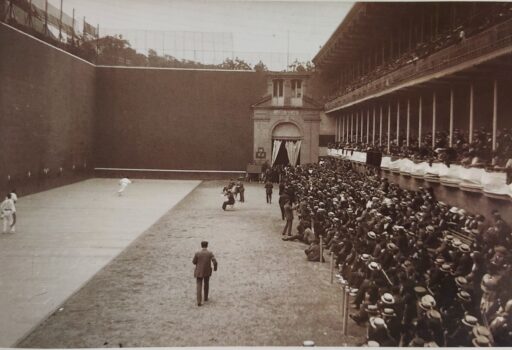
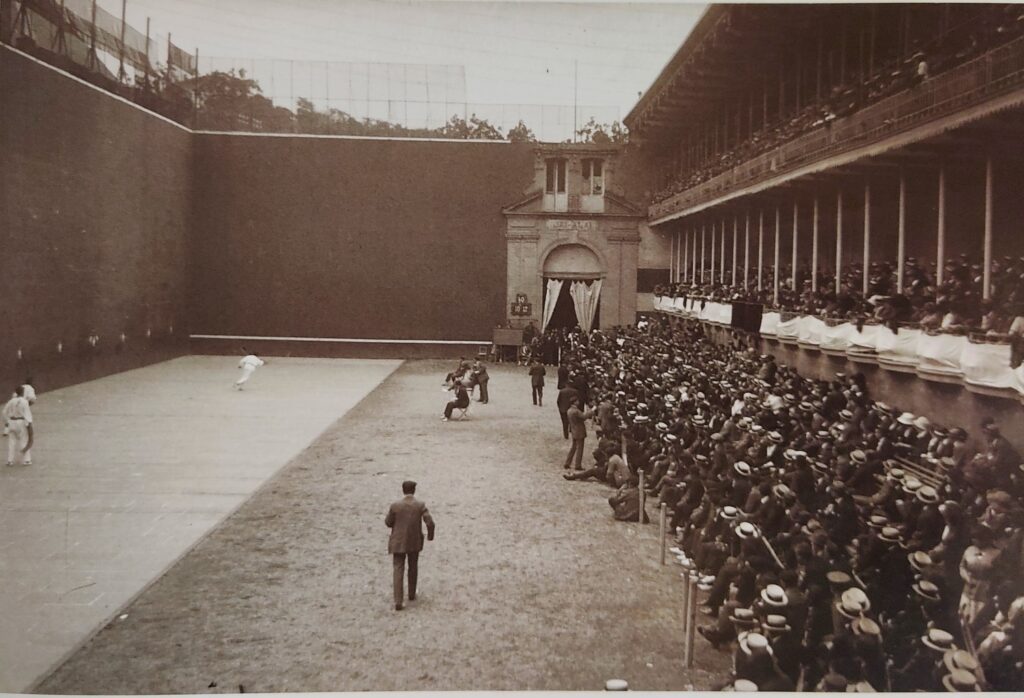
It was against this backdrop of a boom in Basque pelota that the sport’s founding milestone took place: the construction of the Jai Alai Fronton in 1887, in San Sebastián. In the capital of Gipuzkoa – which was already a summer seaside resort for the royal family and the bourgeoisie – the first major fronton for this sport was built.
With a capacity for over 2,300 spectators and 32 boxes, this court – situated where the tunnel of the same name now connects Egia and Gros – welcomed, amongst other distinguished figures, Queen María Cristina.
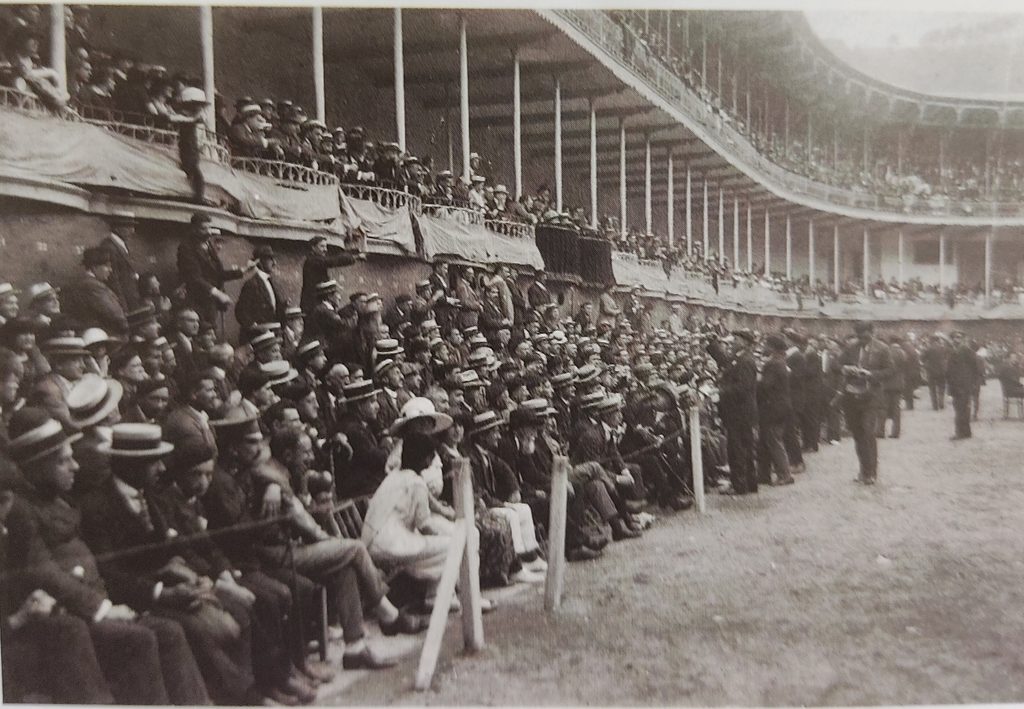
From then on, Basque pelota grew in popularity alongside the industrialisation and professionalisation of the game. It subsequently became widespread through Basque emigration to Latin America, and Basque pelota spread throughout the continent, particularly in countries such as Argentina, Uruguay, Mexico and the United States, where frontons were established and clubs dedicated to the sport were founded, such as the Pan-American Basque Pelota Confederation.
Varieties of Basque pelota
There are many different variants of Basque pelota, depending on the number of players taking part, the equipment used, the dimensions of the court and the type of ball, amongst other factors. The various federations do not all use the same classification system, and the Basque Handball Federation lists a total of 24 variants.
The main types are explained below: those that attract the largest audiences and those that are most widely practised.
Handball: the premier sport
It is the toughest form of the game, and also the oldest. It is the origin of all the others. It is played on frontons (two walls) and trinquets (four walls), either individually or in pairs. Players wear pads to protect their hands, particularly their joints.
Shovel: with a wooden blade
It is one of the most popular forms of the game amongst enthusiasts. It can be played with a wooden racket and a rubber ball (the simplest way, due to the ball’s bounce), or with a leather ball (which requires greater strength and skill). It is always played on two-walled frontons.
Pointed basket: wicker basket with a curved shape
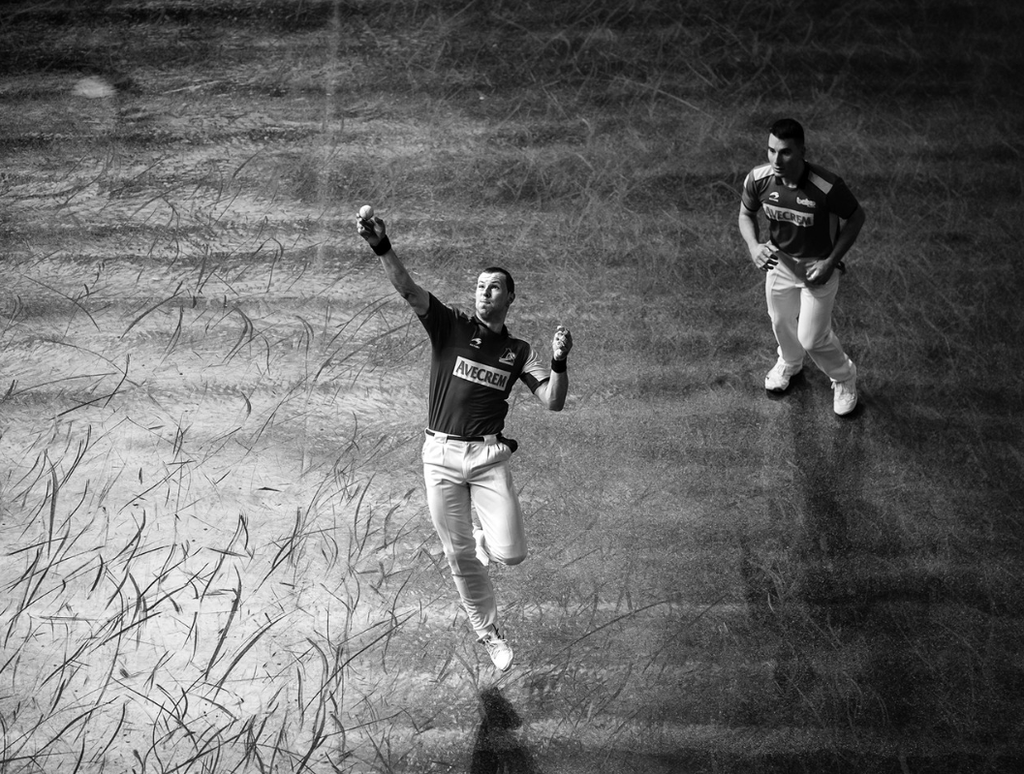
It is the most unique speciality, because the equipment used in the game is specific to Basque pelota. The ‘cesta’ consists of a leather glove and a concave basket made of chestnut wood and wicker. It is a very well-known sport, and therefore played all over the world, and the ball can reach speeds of up to 300 km/h.
Xare: with a wicker racket
The game is played with a piece of kit consisting of a chestnut wood hoop and a net, and a leather ball. The ball is not struck, but thrown with great force, resulting in a very fast-paced game, and is played on trinquetes (not on frontons).
Frontenis: played with a racket and a rubber or tennis ball
Frontenis is played on a fronton using rackets and rubber balls. It is one of the most popular games amongst amateurs because it does not require as much technique or physical power as other games played with leather balls or wooden paddles.
Where to watch Basque pelota
Basque pelota is played in every corner of the Basque Country and Navarre, and you can enjoy a match every weekend. Whilst there are frontons in every neighbourhood, some venues have a longer history.
The most legendary frontons in the Basque Country include the Astelena in Eibar, the Jai-Alai in Gernika, the Atano III in San Sebastián (located in Anoeta), the Galarreta in Hernani, the Ogueta in Vitoria-Gasteiz and the Bizkaia fronton in Bilbao, amongst many others. In Navarre, the legendary Frontón Labrit in Pamplona is a unique venue. And on the other side of the border, Le Trinquet Moderne in Bayonne and the Jaï-Alaï in Saint-Jean-de-Luz are iconic venues for enjoying this sport.
To find out which matches are coming up and where they’ll be played, you can check these schedules:
Interesting facts about Basque pelota
Given the long history of this sport, Basque pelota has left behind anecdotes for posterity. Two of these are of historical significance.
- The French Revolution began on a pelota court: on 20 June 1789, Louis XIV barred the deputies from entering the Assembly, and they gathered at the Jeu de Paume in Versailles. There, they swore to provide France with a constitution during what is known as the Oath of the Pelota Game, the first step of the French Revolution. (*1)
- The Basque pelota basket was used as a weapon during the First World War: it was used by the world champion Chiquito de Gambó to launch grenades, and later by his brother. The commander of the latter’s unit said that he alone was worth a battery of cannons. (*1)
References
- 1. Lesmes Zabalegui, Santiago (2020) La increíble historia de la Pelota Vasca: De par en par.

A journalist with over 20 years of experience in the media, specializing in creative storytelling and informative content. Through Go Local, she connects with the people, places, and events that matter in San Sebastián, reporting with journalistic rigor on the milestones that shape the city’s identity.