The Ladies’ Battery: Military history and routes for visiting it in Donostia
History and defensive role of the battery The Ladies’ Battery was built in the late 16th century, when the Italian engineer Tiburzio Spannocchi – who had been commissioned to renovate the medieval city walls to adapt them to the changing times and new methods of warfare – decided to construct it on the south-western slope […]
Categories
History and defensive role of the battery
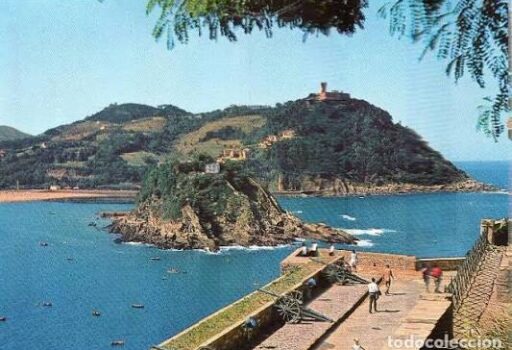
The Ladies’ Battery was built in the late 16th century, when the Italian engineer Tiburzio Spannocchi – who had been commissioned to renovate the medieval city walls to adapt them to the changing times and new methods of warfare – decided to construct it on the south-western slope of Mount Urgull. Previously, the Santa Clara tower had stood on the same site; built just a few years earlier, in 1571, Spannocchi ordered its demolition to make way for the battery.
The battery was situated in a strategic location, as from there one could see the whole of La Concha Bay, the island of Santa Clara, the entrance to the bay and even Mount Igeldo; moreover, it served to fire salutes in honour of the monarchs should they pay a visit.
For centuries it was used for military purposes, of course, until the town ceased to be a military garrison and the site fell into disuse. It was not until 1925 that the town council purchased the hill from the state to turn it into a public space, and work began on the restoration project to adapt the structures to their new use. Consequently, numerous structures belonging to the castle were demolished, but just as many were preserved, as is the case with this battery.
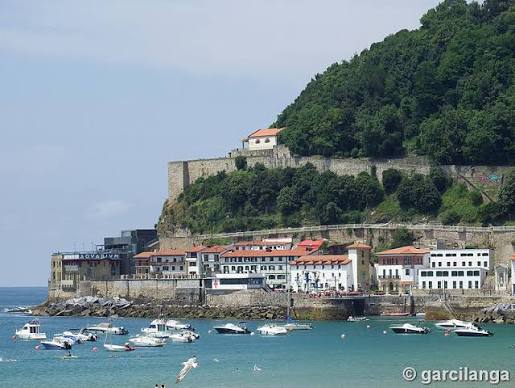
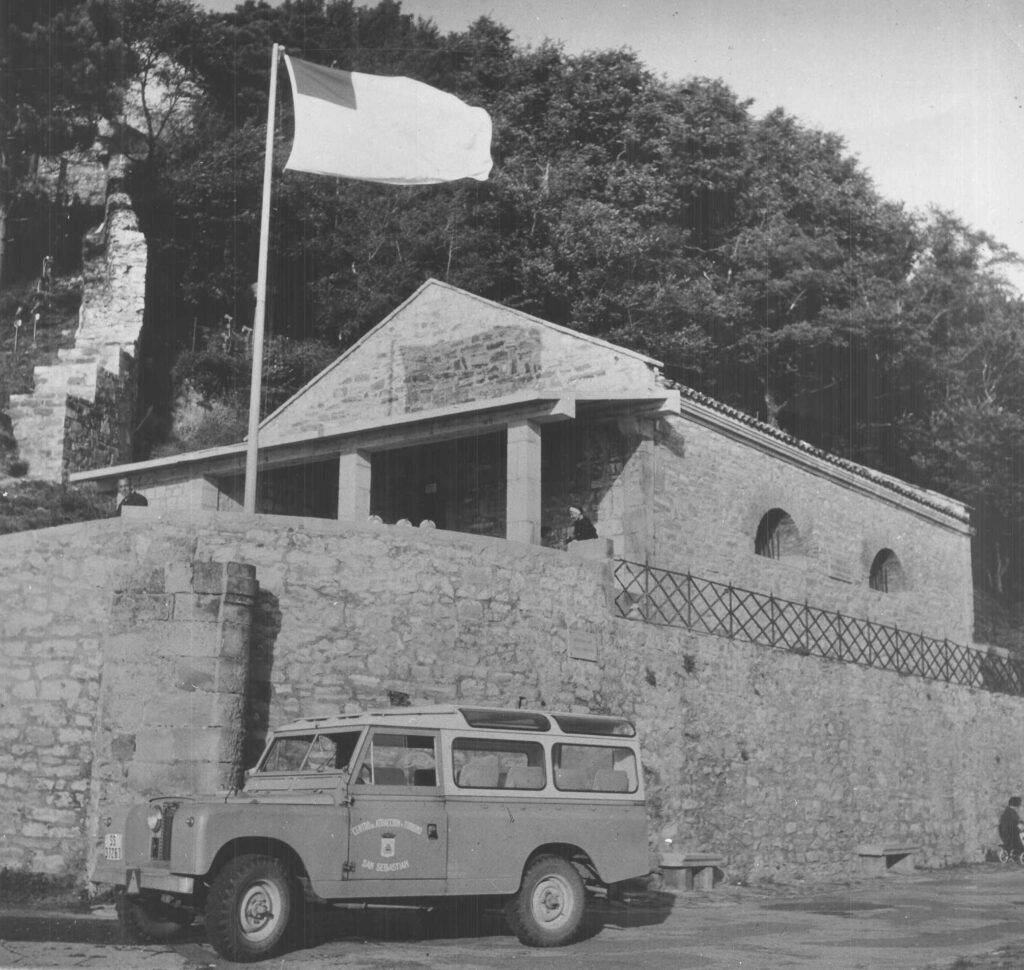
In addition to the lookout point for surveillance and positioning the cannons, the battery comprised a small building for ammunition and another, slightly larger one to house the soldiers. Both were retained during the adaptation work, with the former becoming a venue for storytelling sessions and children’s workshops, and the latter a small children’s library which opens during Holy Week and in the summer. The bastions where soldiers once were stationed now serve as viewing points offering a spectacular view of the bay – perhaps one of the best views in the city thanks to its sweeping panorama across the bay.
Location and how to get there
The battery is situated on the south-western slope of Mount Urgull, clearly visible from La Concha Bay, and easily recognisable by the building that now houses the summer library. Halfway up the slope, it is not difficult to reach this battery, as there is a main path leading to this spot with incredible views. Entering the Old Town via Portaletas, turn left and head straight up until you reach Mount Urgull through a low stone gateway. A little further on, the path forks: the left-hand path leads to the Paseo de los Curas and the right-hand path to the Ladies’ Battery – it’s that simple.
Another way to get there is from the Paseo Nuevo. Climbing the slope just a few metres from Jorge Oteiza’s sculpture ‘Construcción Vacía’, follow the path which, whilst taking a slightly longer route, will lead you to the Lower Santa Clara Battery, which in turn is connected to the Ladies’ Battery. And if you want to get there from the top, there’s a set of very steep steps hidden amongst the trees that take you from the Polvorín area to the battery quickly and directly.
What to see at the Battery
As well as spectacular views of the bay, the island, the Cantabrian Sea and the city, all in one place, you’ll also find the two buildings mentioned earlier here, which are almost a must-see if you’re visiting with children during the summer season.
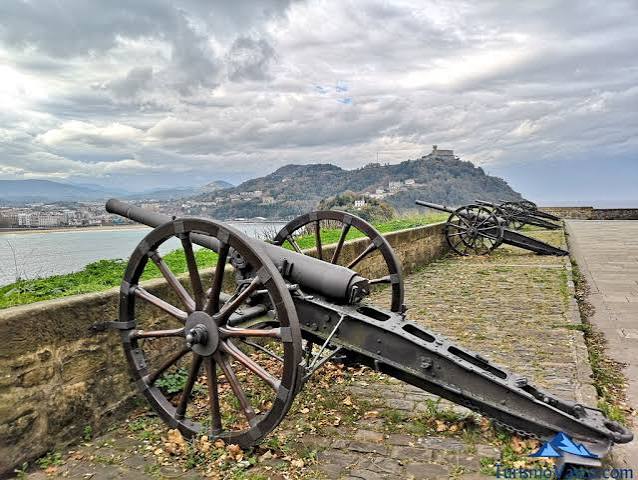
Here, too, we have four 7.5-centimetre Saint-Chamond guns mounted ‘on a barbette’, which means they fire over the wall rather than through open embrasures in it. These guns date from the war with Morocco, but they are not the only ones to have surveyed the bay from here, as they have been replaced over time as artillery technology has advanced. Nowadays, they are obviously unusable, and their main purpose is to serve as props in photographs and children’s games; indeed, it is not uncommon to see children climbing on top of them as if they were horses.
Nearby routes and trails
The whole of Mount Urgull is an excellent place for walking, as it is criss-crossed with paths and trails. Some of these are clearly visible, such as the Paseo de los Curas, just below the Ladies’ Battery; others, however, are hidden away and lead to unexpected places, such as the path that leads to the shooting gallery on the other side of the mountain.
Some are easy to follow, as they are tarmacked and not particularly steep; others, by contrast, wind their way through the trees and feature steep, damp steps where you need to tread carefully.
Be that as it may, no matter which path or track you choose, you’ll never be too far off course, as the way down from the hill is always towards the sea. Here, at the foot of the hill, lies one of the city’s most famous promenades: the Paseo Nuevo, which circles the hill along the coast and is particularly lovely to walk along at sunset.
Historical curiosities and local anecdotes
The most interesting fact about the Ladies’ Battery is, in fact, its name. Near what is now the Paseo Nuevo, there used to be a water fountain which the women of San Sebastian frequented, as fountains were scarce in a city surrounded by walls and seawater. The soldiers stationed on mount Urgull, with no women up there, would come down to the path to flirt with the women of San Sebastian, hence the name ‘Ladies’ Battery’ or ‘Women’s Battery’. It may well be that more than one resident of San Sebastian is a descendant of those romantic encounters – who knows!
Another interesting fact is that the wall supporting the summer library is used by young climbing enthusiasts to practise their sport in the open air. Its irregularly shaped and sized stones are a delight for these climbers, who are thus able to exercise in a place steeped in history and offering fantastic views – even if, most of the time, they have their backs to them.

My name is Alba, and although my first name doesn’t sound very Basque, my unpronounceable surname proves otherwise. I’ve lived in Donostia all my life. I’m an art historian and have been a tour guide for many years; I love travelling, languages and, of course, art.